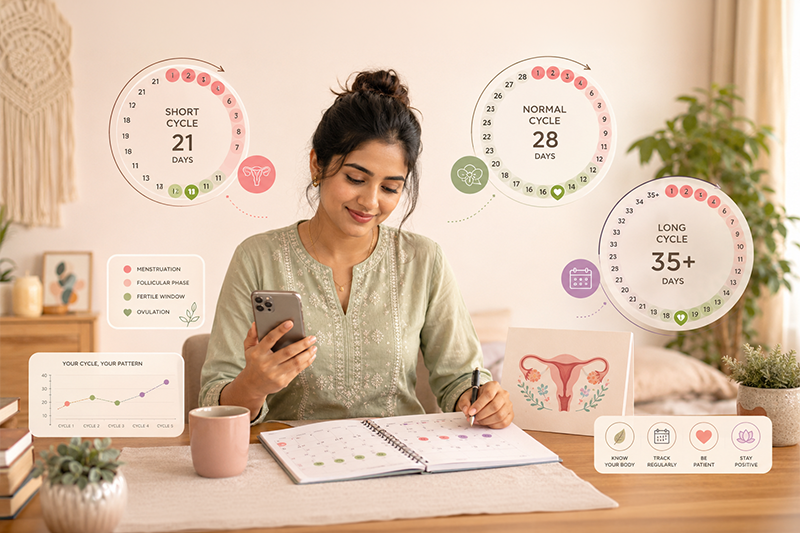
A normal period cycle length ranges from 21 to 35 days, with 28 days being the most commonly cited average. Short cycles (under 21 days) can indicate hormonal imbalance, low ovarian reserve, or perimenopause. Long cycles (over 35 days) are often associated with PCOS, thyroid disorders, or anovulation. According to ACOG, both extremes can affect fertility, but most women with irregular cycles can still conceive with the right support and tracking.
What is a normal period cycle length?

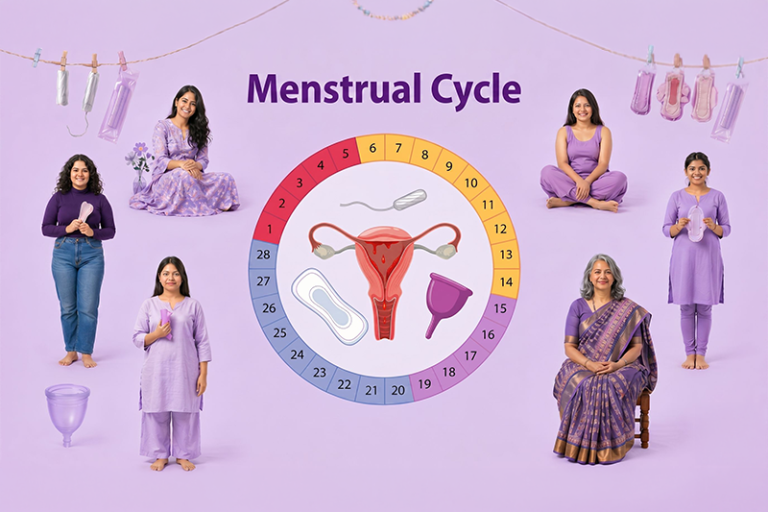
A normal period cycle length is 21 to 35 days, measured from the first day of one period to the first day of the next. According to menstrual cycle classification indexed in the National Library of Medicine, cycles shorter than 21 days are termed polymenorrhoea and cycles longer than 35 days are termed oligomenorrhoea. The duration of one full cycle is simply called the menstrual cycle, and a length anywhere in the 21 to 35 day range can be perfectly healthy.
The 28-day standard is largely a myth. A 2018 analysis published through Taylor & Francis Online found that only about 15% of women have a true 28-day cycle, while around 34% assume they do. This gap matters because calendar-based predictions in the same research were only about 21% accurate in identifying the fertile day.
The table below compares the three cycle types and what each may suggest.
| Cycle type | Length | What it may indicate | Fertility note | Suggested tracking action |
|---|---|---|---|---|
| Polymenorrhoea (short) | Under 21 days | Hormonal variation or a shorter follicular or luteal phase | Very short cycles may be linked with reduced fecundability | Track LH and BBT to see whether ovulation is happening |
| Normal | 21 to 35 days | Regular, ovulatory cycles | Generally associated with healthy ovulation | Log cycle length and test LH around the fertile window |
| Oligomenorrhoea (long) | Over 35 days | Delayed or variable ovulation, often PCOS-related | Conception is still possible; prediction just takes longer | Extend LH testing and confirm the shift with BBT |
What is the optimal cycle length for fertility?
Cycles of roughly 25 to 35 days are generally associated with the most consistent ovulation, which supports conception. The key factor is not a specific number but regularity: a cycle that arrives in a predictable range month after month usually signals that ovulation is occurring. A 27-day cycle, for example, typically places ovulation near day 13, with the fertile window in the days just before.
When do you ovulate on a 30, 35, or 40-day cycle?

Ovulation usually happens about 11 to 17 days before your next period, because the luteal phase stays relatively stable while the follicular phase stretches or shortens. So, on a longer cycle, ovulation simply arrives later. A practical estimate is to subtract about 14 days from your typical cycle length, then watch for your LH surge around that time.
This table gives approximate timing by cycle length. Treat these as starting points, not fixed dates.
| Cycle length | Approximate ovulation day | Estimated fertile window | Typical luteal phase |
|---|---|---|---|
| 21 days | Around day 7 | Days 3 to 8 | 11 to 17 days |
| 24 days | Around day 10 | Days 6 to 11 | 11 to 17 days |
| 28 days | Around day 14 | Days 10 to 15 | 11 to 17 days |
| 30 days | Around day 16 | Days 12 to 17 | 11 to 17 days |
| 35 days | Around day 21 | Days 17 to 22 | 11 to 17 days |
| 40 days | Around day 26 | Days 22 to 27 | 11 to 17 days |
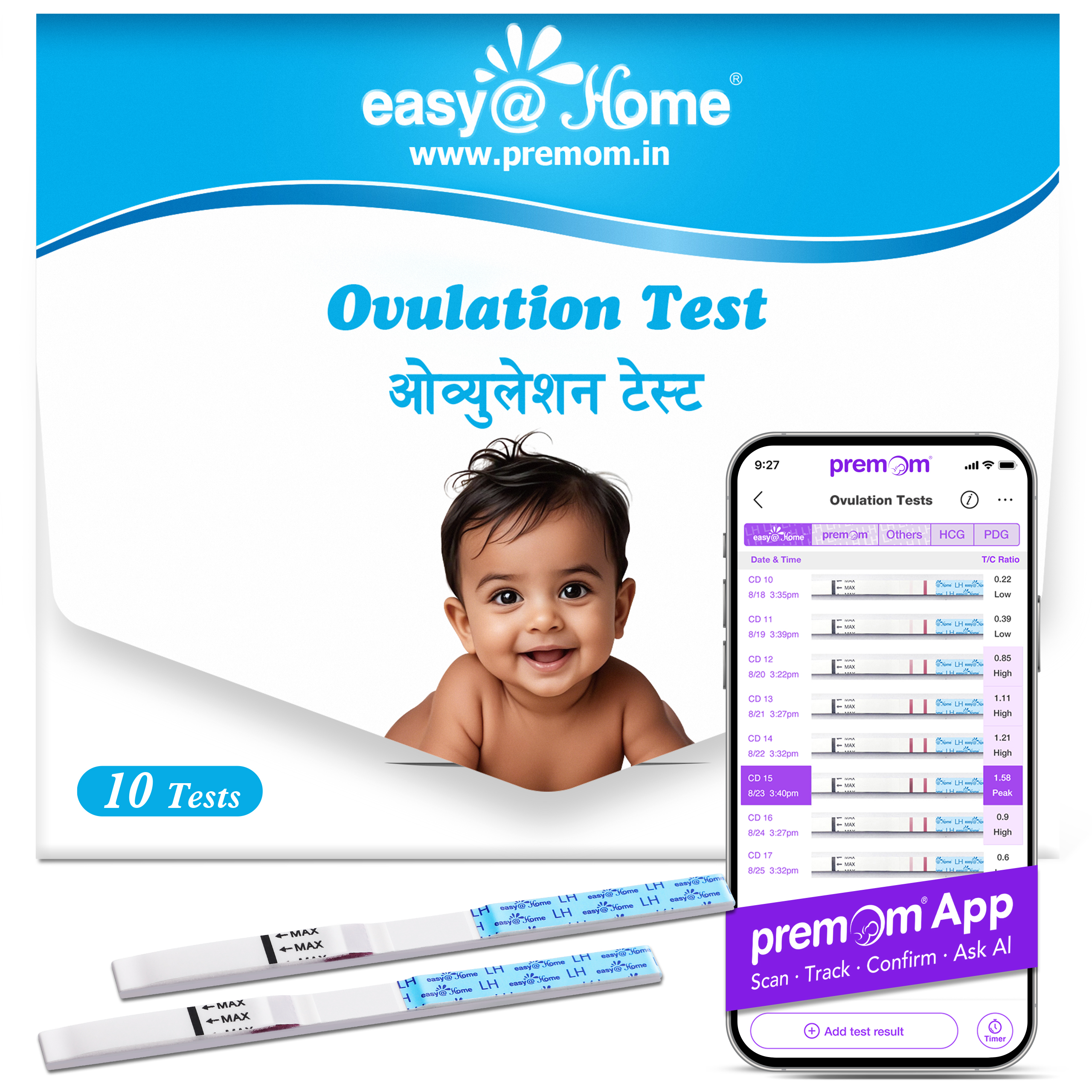
Because ovulation timing varies, calendar estimates are a guide rather than a guarantee. Logging your cycle length in Premom and testing your LH surge with easy@Home quantitative strips gives a far more personal signal. The Premom photo-reader records the numerical LH value and builds your own baseline, which is especially helpful when cycles run long or irregular, and a single calendar guess would miss the mark.
Short menstrual cycle: What does it mean?
A short menstrual cycle is one under 21 days, although many people simply notice their cycle drifting from 28 to 25 days. A short cycle often points to a shorter follicular phase, meaning ovulation comes earlier, or sometimes a shorter luteal phase. Hormonal changes, stress, thyroid variation, and the years approaching perimenopause are common and manageable reasons a cycle gets shorter over time.
Why did my cycle change from 28 to 31 days?
A shift from 28 to 31 days is usually a normal variation, not a problem. Cycle length naturally fluctuates with stress, sleep, travel, weight change, illness, and age. A few days of month-to-month variation are expected. If you want to understand a short menstrual cycle pattern, track several cycles before concluding, and watch for when your LH surge actually appears.
Why is my menstrual cycle getting shorter?
A gradually shorter cycle can reflect changes in how your follicles develop, which is common as you move through your thirties and forties. A period that is also shorter and lighter than usual may simply mean a thinner uterine lining that month. These shifts are often harmless, but persistent or sudden changes are worth discussing with a doctor, especially alongside pain or unusual bleeding.
Do shorter cycles mean you are more fertile?
Not necessarily. A short cycle does not automatically mean you are more fertile, and a longer one does not automatically mean you are less fertile. What matters is whether you ovulate and whether your luteal phase is long enough, normally 11 to 17 days, to support implantation. A luteal phase under 10 days may make conception harder and is worth raising with a clinician.
Do shorter cycles mean poor egg quality?
No, a short cycle by itself does not mean poor egg quality. There is no direct evidence that cycle length measures egg quality. However, research from Boston University School of Public Health in 2016 found that cycles of 26 days or fewer were associated with reduced fecundability on average. That is a population trend, not a personal diagnosis, and many women with short cycles conceive.
Does a 2-day period affect fertility?
A two-day period is not necessarily a fertility problem. Flow length and fertility are separate things. A short, light period can be normal for you, or it may be due to hormonal birth control, stress, or a thinner lining. Fertility depends on ovulation, so tracking your LH surge tells you more than period length alone. Mention any sudden change to your doctor.
Long menstrual cycle: What a 35, 40, or 45-day cycle means
A long menstrual cycle is one over 35 days, classed as oligomenorrhoea. On a 40-day cycle, ovulation often falls around day 26, with the fertile window in the preceding days. A long cycle is not automatically bad. It usually means ovulation is delayed or variable, so it takes longer to identify your fertile days, rather than meaning you cannot conceive.
Is a 40-day cycle bad for fertility?
A 40-day cycle is not inherently bad, but it can make timing more difficult and may indicate less frequent ovulation. Fewer cycles per year means fewer natural chances to conceive, so identifying ovulation matters more. Common and manageable causes include PCOS, thyroid variation, and stress. Consistent tracking and a doctor’s input if cycles are very long help clarify what is happening.
Do longer cycles mean you are less fertile?
Longer cycles can be linked with less frequent ovulation, which can lengthen the time to conceive, but they do not rule out pregnancy. In India, irregular and long cycles are frequently connected to PCOS, a common and manageable hormonal condition that is a recognised cause of irregular ovulation. With PCOS, baseline LH can run higher, so a personal LH baseline is more useful than a single universal threshold. Reviewing your long cycles and fertility patterns, and your irregular periods and fertility history with a doctor is a sensible next step.
Regular periods but not getting pregnant, what is happening?
Regular periods strongly suggest you ovulate, but they do not confirm it, and timing intercourse to the fertile window is what counts. You might be ovulating earlier or later than the calendar predicts, or have a short luteal phase. Tracking your LH surge across a few cycles often reveals the mismatch. If you have tried for 6 to 12 months, speak with a fertility specialist.
What are the signs that you are very fertile?
Signs of healthy, fertile cycles tend to appear together rather than as one clue. Look for a regular 25 to 35 day cycle, a clear LH surge, stretchy egg-white cervical mucus near ovulation, a small rise in basal body temperature ( about 0.5°F to 1°F, which is about 0.3°C to 0.6°C) afterwards, mild mid-cycle cramping, and a healthy period. None of these guarantees conception, but together they suggest that ovulation occurs on a predictable schedule.
A regular 21-day ovulation cycle, or any consistent rhythm, is a positive sign because regularity itself reflects a functioning hormonal cycle.
How to track your cycle length and find your fertile window
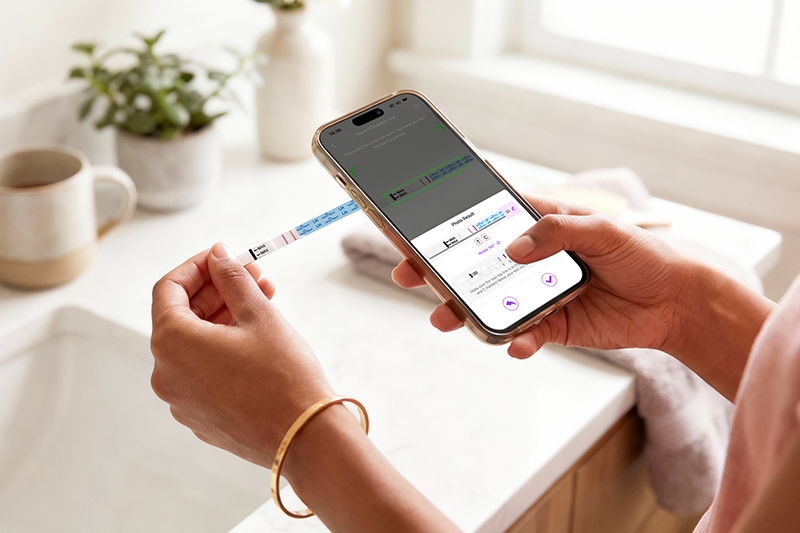
The most reliable way to find your fertile window in a short, long, or irregular cycle is to follow your own hormones rather than an average. easy@Home and Premom work as one fertility tracking system: when you test your LH with easy@Home quantitative ovulation strips, the Premom app helps record your numerical LH values, build your personal baseline, chart your basal body temperature, and store cervical mucus and symptom notes in one place.
Premom is a fertility-tracking app that works with easy@Home ovulation tests, reading test strips to record quantitative LH values and charting BBT, so users can see their cycle patterns over time. LH data indicate when ovulation may be approaching, and a basal body temperature rise of about 0.5 to 1.0 degrees Fahrenheit (0.28 to 0.56 degrees Celsius) can be used to retrospectively identify the post-ovulatory shift. Ovulation typically follows about 28 to 36 hours after the LH rise begins, though timing varies.
For long or irregular cycles, start testing after your period ends and keep testing until your next period, rather than guessing from the calendar. One safety tip matters: read and photograph each test within the instruction window, usually about 5 to 10 minutes, because results can become invalid once a strip dries out.
If your cycle length makes it hard to know when you ovulate, start logging your cycle and use easy@Home ovulation test strips with the Premom app to track your LH surge more clearly. Building a personal baseline over a few cycles may help you identify your most fertile days, even when your cycles are short, long, or irregular.
Key takeaways
- The 28-day cycle is a myth for most people. Research published in 2018 suggests only about 15% of women actually have a 28-day cycle, even though around 34% believe they do.
- A normal period cycle length spans 21 to 35 days, and cycles of roughly 25 to 35 days are often associated with healthy, regular ovulation.
- Very short cycles of 26 days or fewer have been linked with reduced fecundability, but a short cycle on its own does not mean poor egg quality.
- Long or irregular cycles are common and usually manageable. They are often connected to PCOS, where ovulation may simply happen later or vary from month to month.
- Tracking your LH surge and basal body temperature gives a personal picture of your fertile window that calendar maths cannot.
Key terms explained
- Follicular phase: The first part of the cycle, from the start of your period until ovulation, when an egg matures. Its length varies the most between people.
- Ovulation: The release of a mature egg from the ovary, usually once per cycle.
- Luteal phase: The time from ovulation to your next period, normally 11 to 17 days.
- LH surge: A sharp rise in luteinising hormone that precedes ovulation, the signal that ovulation tests detect.
- Fertile window: The roughly six days ending on ovulation day when conception is most likely.
- Oligomenorrhoea: Infrequent periods, defined as cycles longer than 35 days.
- Polymenorrhoea: Frequent periods, defined as cycles shorter than 21 days.
Disclaimer: This article is for educational purposes only and is not a substitute for medical advice. Please consult a qualified healthcare provider for personalised guidance.