Why are my periods so irregular?” This is the most common concern I hear from women.
In many cases, the issue stems from Polycystic Ovary Syndrome (PCOS). PCOS is a hormonal condition that affects women during their reproductive years, and irregular periods are often the first noticeable sign. In this blog, I want to help you understand why PCOS causes irregular or delayed periods, what other PCOS symptoms you should be aware of, and how the right PCOS treatment and self-care can help improve your menstrual cycle.
What is a normal period cycle?
A normal period cycle usually ranges between 21 and 35 days, with bleeding lasting around 3-7 days. The cycle depends on one key event: ovulation.
When ovulation happens on time, hormones follow a predictable pattern, and your period arrives on time. When ovulation is delayed or does not happen at all, periods can be delayed, irregular, or even stop for months.
This is what happens to many women with PCOS.
Why does PCOS cause irregular periods?
1. Lack of ovulation (Anovulation)

The most important reason for irregular periods in PCOS is irregular or absent ovulation.
In PCOS, the ovaries often contain more follicles than normal, typically more than 10-12 small follicles in each ovary, which is a common ultrasound finding in PCOS.
In a normal menstrual cycle:
- Several follicles begin to develop
- Only one dominant follicle matures
- That follicle releases one egg during ovulation
In PCOS:
- Many small follicles are present
- A dominant follicle often fails to fully mature
- As a result, the egg is not released (anovulation)
In the absence of ovulation, the body does not produce enough progesterone, a hormone that signals the uterus to shed its lining. Without progesterone, periods are delayed or missing. This is why many women with PCOS experience irregular cycles.
2. Hormonal imbalance and high androgens
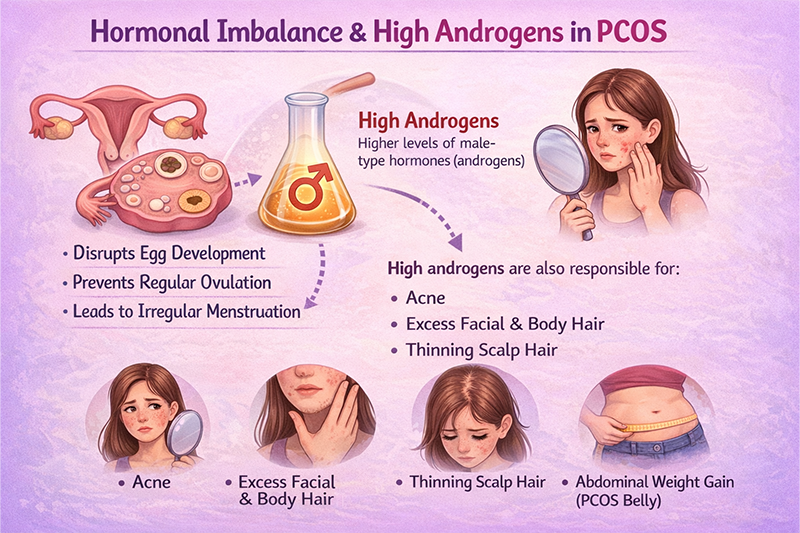
PCOS is primarily a hormonal disorder. Many women with PCOS have higher levels of androgens (male-type hormones).
This hormonal imbalance:
- Disrupts egg development
- Prevents regular ovulation
- Leads to irregular menstruation
High levels of androgens are also responsible for other common PCOS symptoms, such as acne, excess facial or body hair, thinning of scalp hair, and abdominal weight gain (known as PCOS belly).
3. Insulin resistance

Insulin resistance is also a major cause of irregular periods in PCOS.
When the body does not respond properly to insulin:
- Insulin levels rise
- Ovaries produce more androgens
- Ovulation becomes even more irregular
This creates a cycle where insulin resistance worsens hormonal imbalance, leading to persistent period irregularities. Even women who are not overweight can have insulin resistance, making it an important but often overlooked factor.
4. Imbalance of LH and FSH hormones

In many women with PCOS, the balance between LH (Luteinizing Hormone) and FSH (Follicle Stimulating Hormone) is altered.
Typically, in PCOS:
- LH levels are higher than normal
- FSH levels are relatively low
This imbalance prevents proper follicular maturation and ovulation, leading to delayed period and irregular cycle lengths.
5. Irregular shedding of the uterine lining

When ovulation does not occur regularly:
- Estrogen continues to thicken the uterine lining
- Progesterone is insufficient to regulate shedding
As a result, periods may:
- Occur after long gaps
- Be very heavy or prolonged
- Appear as spotting instead of a proper flow
These patterns are common signs of irregular menstruation in PCOS.
Common period problems seen in PCOS
Women with PCOS often experience:
- Cycles longer than 35-40 days
- Missed periods for several months
- Very heavy bleeding after a delayed period
- Spotting between cycles
- Difficulty predicting fertile days because ovulation does not happen at the expected time
These symptoms indicate a disrupted period cycle and ovulation.
PCOS test: How is PCOS diagnosed?
There is no single test for PCOS diagnosis. It usually includes a combination of:
- Reported history of irregular/delayed periods
- Hormone test for high androgen levels
- Blood tests for insulin and other hormones
- Pelvic ultrasound findings
| Diagnostic Component | What It Evaluates | Why It Matters |
| Menstrual History | Irregular, delayed, or absent periods | Indicates irregular ovulation and/or anovulation and hormonal imbalance |
| Androgen Hormone Test | Elevated testosterone or other male hormones | Explains symptoms like acne, hirsutism, or hair thinning |
| Metabolic Blood Tests | Insulin levels, fasting glucose, lipid profile | Checks for insulin resistance and metabolic risks, including prediabetes, type 2 diabetes, high cholesterol, high triglycerides, and an increased risk of cardiovascular disease. |
| Pelvic Ultrasound | Ovarian appearance and follicle count | Looks for polycystic ovarian morphology |
Important note:
A diagnosis of PCOS does not depend solely on the presence of ovarian cysts on ultrasound.
Doctors usually evaluate a combination of:
- Irregular or absent ovulation
- Clinical or laboratory signs of elevated androgens
- Polycystic ovarian morphology on ultrasound
Typically, meeting two out of three criteria is enough for diagnosis (Rotterdam criteria).
PCOS self care to improve period regularity
In my experience, regular PCOS self-care plays a critical role in improving menstrual health.
This includes:
- A balanced, low-glycaemic diet
- Regular physical activity
- Stress management
- Adequate sleep
- Tracking cycles and ovulation patterns
- Weight management, especially reducing abdominal fat
Small, consistent changes can make a significant difference over time.
Irregular menstruation treatment in PCOS
Treatment of irregular menstruation depends on your symptoms and whether you are trying to conceive. Treatment includes:
- Lifestyle modifications
- Addressing insulin resistance
- Supporting ovulation
- Hormonal regulation under medical supervision
Early treatment helps prevent long-term complications such as endometrial thickening and metabolic issues such as prediabetes, type 2 diabetes, high cholesterol, high triglycerides, and increased risk of cardiovascular disease.
If you have irregular periods or suspect PCOS, early awareness and cycle tracking can make a meaningful difference. Start understanding your cycle today and take the first step towards better hormonal health. For more useful insights on PCOS and menstrual health, read our blogs. To clarify your PCOS-related questions, ask our experts.
Frequently asked questions (FAQs)
In PCOS, periods are often irregular because ovulation does not happen regularly. When ovulation is delayed or absent, progesterone is not produced properly. This causes delayed, missed, or unpredictable periods in women with polycystic ovary syndrome.
In PCOS, cycles can be longer than 35 to 40 days. Some women may miss periods for 2 to 3 months or even longer. This happens due to hormonal imbalance and lack of ovulation.
Yes. PCOS can cause missed periods for several months because the ovaries do not release the egg regularly. Without ovulation, the uterine lining does not shed on time, leading to absent menstruation.
Yes. When a period is delayed for a long time in PCOS, the uterine lining becomes thick. When it finally sheds, bleeding may be heavier or last longer than usual.
Common PCOS symptoms include:
* Acne
* Excess facial or body hair
* Hair thinning on the scalp
* Weight gain, especially around the abdomen
* Difficulty getting pregnant
* Darkened skin patches
These symptoms occur due to high androgen levels and insulin resistance.
Yes. Many women with PCOS can improve cycle regularity with lifestyle changes such as healthy eating, regular exercise, stress management, adequate sleep, and weight control. Appropriate medical treatment and doctor-recommended supplements, such as inositol or vitamin D if deficient, may also help regulate ovulation and improve menstrual cycles.
Yes. Insulin resistance increases insulin levels in the body. High insulin stimulates the ovaries to produce more androgens, which disrupt ovulation and lead to irregular menstruation in PCOS.
PCOS diagnosis usually includes:
* History of irregular or delayed periods
* Blood tests to check hormone levels
* Insulin testing
* Pelvic ultrasound
Yes, pregnancy is possible with PCOS. However, irregular ovulation can make it harder to predict fertile days. Tracking ovulation with Ovulation Predictor Kits (OPKs) and seeking proper medical support can improve chances of getting pregnant.
You should consult a doctor if:
* Your cycles are longer than 35 days
* You miss periods for more than 2 to 3 months
* Your bleeding is very heavy or prolonged
* You have symptoms like acne, excess hair growth, or weight gain
Early diagnosis and treatment of PCOS can help prevent long-term complications.
References
- Centers for Disease Control and Prevention (CDC) – PCOS Overview
https://www.cdc.gov/diabetes/basics/pcos.html - Office on Women’s Health (U.S. Department of Health & Human Services) – Polycystic Ovary Syndrome
https://www.womenshealth.gov/a-z-topics/polycystic-ovary-syndrome - National Institute of Child Health and Human Development (NICHD) – Polycystic Ovary Syndrome (PCOS)
https://www.nichd.nih.gov/health/topics/pcos - MedlinePlus – Polycystic Ovary Syndrome
https://medlineplus.gov/polycysticovarysyndrome.html - Cleveland Clinic – Polycystic Ovary Syndrome (PCOS)
https://my.clevelandclinic.org/health/diseases/8316-polycystic-ovary-syndrome-pcos - World Health Organization (WHO) – Polycystic Ovary Syndrome (PCOS)
https://www.who.int/news-room/fact-sheets/detail/polycystic-ovary-syndrome