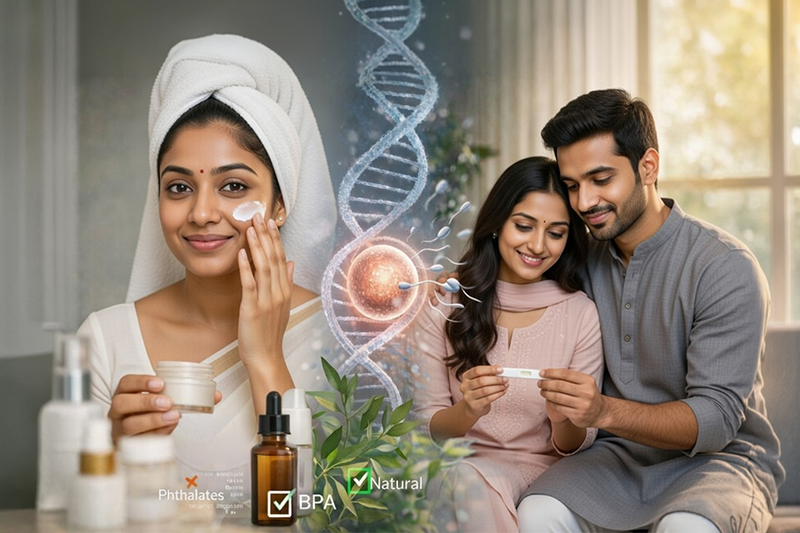
While many women are aware of how a good diet and lifestyle affect conception, few know about the impact of daily cosmetics and skin care products on reproductive health. Learning about the link between your skin and fertility can actually help you reduce the risk of infertility.
Can skincare affect fertility?
Many people wonder: Can skincare affect fertility? The truth is that your skin and your reproductive system are deeply connected through hormones.
How do hormones connect skin and reproductive health?
Your skin is one of the first organs to react to hormone changes. Often, your skin shows a hormonal imbalance even before your periods become irregular.
Why does skin change when trying to conceive?
When you are trying to conceive, your body undergoes a hormonal change. Fluctuations in estrogen and progesterone can cause your skin to shift from dry to oily.
Scientific evidence behind skincare and fertility
Certain chemicals in beauty products can act as endocrine disruptors. These chemicals may interfere with the natural hormones that are needed to conceive a baby.
How beauty products may impact fertility and conception
Using the wrong beauty products during conception can lead to unintended risks.
Endocrine disruptors explained
It’s a chemical that mimics your natural hormones. This can trick your body into thinking it has more or less of a certain hormone than it actually does.
How chemicals affect ovulation
If hormones are off-balance due to chemical exposure, it can affect your fertile window and make ovulation unpredictable.
Fertility risk vs safe exposure
While a single use of a product is a low fertility risk, the daily buildup of several products can add up over time.
Ingredients to avoid when trying to conceive
To protect your reproductive health, keep an eye out for these ingredients.
Retinoids & Vitamin A derivatives
While great for anti- ageing, retinoids should only be used on medical advice. Most experts suggest pausing them when you start trying to conceive.
Parabens and phthalates
These are common preservatives in beauty products. They are known as endocrine disruptors that can interfere with your ability to conceive.
BPA and synthetic fragrances
“Fragrance” is often a blanket term for many hidden chemicals. Choosing fragrance-free skin care is often a safer choice for fertility.
Hydroquinone & chemical sunscreens
Some chemical sunscreens can enter the bloodstream. Stick to mineral-based sunscreens (zinc or titanium) to keep your reproductive health a priority.
Why hormones affect both skin health and fertility
Acne and infertility connection
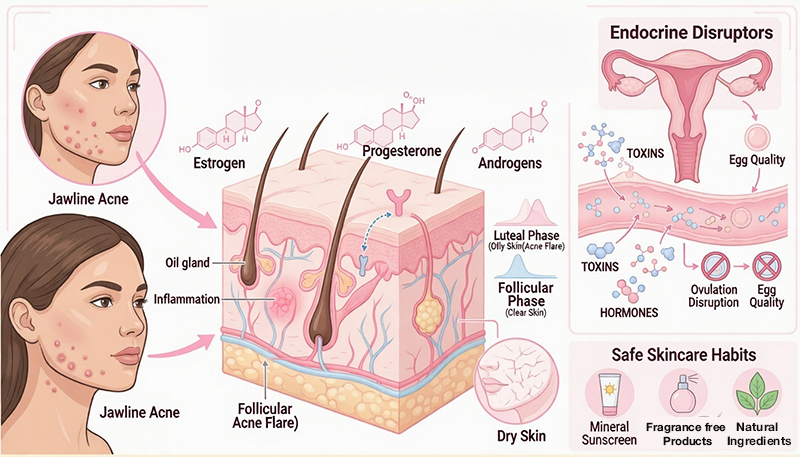
Recurring jawline acne is often linked to higher androgen levels. Since high androgens can stop ovulation, this type of acne may be a signal of infertility issues.
PCOS and skin symptoms
Polycystic Ovary Syndrome (PCOS) frequently manifests through skin changes like chronic oiliness and Acanthosis Nigricans – dark, thickened, velvety patches typically found on the neck, underarms, or groin. These skin signals suggest insulin resistance, which is a major factor in reproductive health.
Estrogen, progesterone and skin balance
Estrogen keeps skin hydrated, while progesterone increases oil. A drop in estrogen mid-cycle can lead to dry or dull skin.
Common Skin Changes While Trying to Conceive
- Acne breakouts: Often caused by increased testosterone activity
- Dryness and sensitivity: Can happen during the lowest estrogen phase
- Hyperpigmentation: Darkening of the skin due to hormonal shifts
- Increased oil production: A common sign of high progesterone
Safe skin care routine when trying to conceive
- Pregnancy-safe ingredients: Switch to Vitamin C, Bakuchiol, and Hyaluronic Acid
- Minimal skincare routine: Use fewer beauty products to reduce your toxic load
- Dermatologist-approved habits: Always consult a professional before using active drugs or treatments
How fertility tracking helps improve conception chances
Premom helps you understand your cycle so your skin symptoms don’t feel like a mystery.
- Hormone tracking: See exactly when your hormones rise and fall
- Fertile window awareness: Know the best days to conceive
- Cycle prediction: Use the Premom app to find patterns in your fertile window and skin flares
How to get pregnant fast while protecting reproductive health?
To get pregnant fast, you must pair timing with health. Focus on timing intercourse using ovulation tests, reducing toxin exposure in your beauty products, and optimising your lifestyle.
When should you see a doctor for infertility?
You should consult a specialist regarding difficulty conceiving if you:
- are under 35 and have been trying for 12 months
- are over 35 and have been trying for 6 months
- have severe hormonal symptoms like irregular periods and cystic acne
Take control of your fertility journey with Premom
Your skin might be whispering clues about your hormones, but you don’t have to guess what they mean. The Premom app empowers you to see the full picture of your reproductive health. By tracking your LH levels and monitoring your unique cycle patterns, you can identify your most fertile window with precision and confidence.
Ready to align your skincare, your lifestyle, and your cycle? [Download the Premom App Today] and join millions of women who are navigating their path to conception with clarity and data-backed support.
Frequently Asked Questions (FAQ’s) – Link Between Your Skin Health and Fertility
Yes, certain ingredients can act as endocrine disruptors, potentially affecting your ability to conceive.
While they may not be the sole cause, the cumulative effect of some chemicals can disrupt hormones and contribute to infertility.
It is generally recommended to avoid retinoids when trying to conceive; use them only with a dermatologist’s advice.
Yes, jawline acne and oily skin can be signs of hormonal imbalances that affect ovulation.
Medical Disclaimer: This content is for informational purposes only and is not a substitute for professional medical advice, diagnosis, or treatment. Always consult with a healthcare provider regarding any medical condition or before changing your skincare or fertility routine.
References
- Vessa B, Perlman B, McGovern PG, Morelli SS. Endocrine disruptors and female fertility: a review of pesticide and plasticiser effects. F S Rep. 2022;3(2):86-90. Published 2022 Apr 15. doi:10.1016/j.xfre.2022.04.003, https://pmc.ncbi.nlm.nih.gov/articles/PMC9250118/
- Raghunath RS, Venables ZC, Millington GWM. The menstrual cycle and the skin. Clin Exp Dermatol. 2015;40(2):111-115. doi:10.1111/ced. 12588, https://pubmed.ncbi.nlm.nih.gov/25683236/
- Rotterdam ESHRE/ASRM-Sponsored P
- COS Consensus Workshop Group. Revised 2003 consensus on diagnostic criteria and long-term health risks related to polycystic ovary syndrome (PCOS). Hum Reprod. 2004;19(1):41-47. doi:10.1093/humrep/deh098, https://pubmed.ncbi.nlm.nih.gov/14688154/
- American Academy of Dermatology. Acne: Diagnosis and treatment. Accessed March 4, 2026. https://www.aad.org/public/diseases/acne/derm-treat/treat