Missed Period but Not Pregnant?
Missing a period can be worrying, especially when you are trying to understand what your body is telling you. While pregnancy is a common reason for a missed period, it is not the only one. Many physical, hormonal, and lifestyle factors can delay or stop your menstrual cycle.
Understanding how your menstrual cycle works can help reduce fear and confusion. Let us walk through what may cause a late period and when it may be helpful to seek medical advice.
What is menstruation or period?
Menstruation is the monthly shedding of the lining of the uterus when pregnancy does not occur. This lining leaves the body as blood and tissue through the vagina.
A normal period cycle for many women ranges between 21 and 35 days. However, cycles can vary. Some variation may occur from month to month.
How the menstrual cycle works
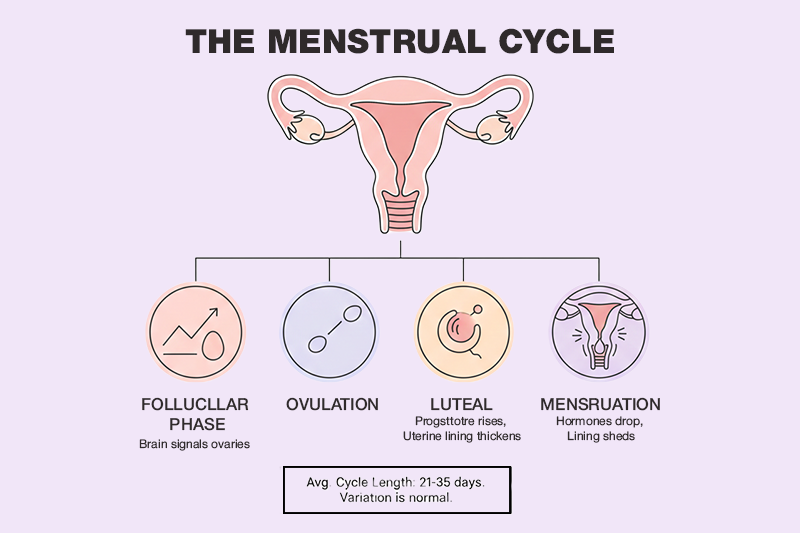
Your menstrual cycle is controlled by hormones.
Here is a simplified overview:
- The brain signals the ovaries.
- One ovary releases an egg (called ovulation)
- After ovulation, the hormone progesterone rises
- If pregnancy does not occur, hormone levels drop
- Your period begins
If ovulation is delayed, your period will also be delayed. This is one of the most common reasons for delayed periods.
Most common reasons for a delayed period (other than pregnancy)
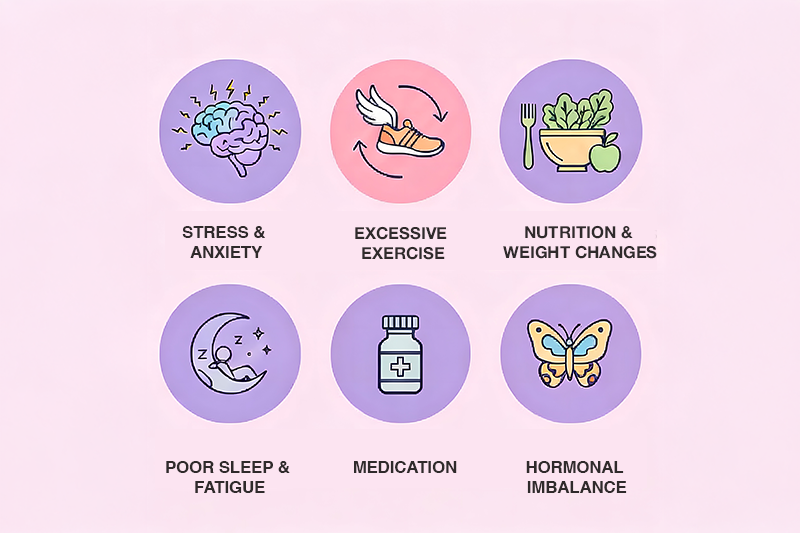
Below is a simplified table of common causes.
| Possible Cause | How It May Affect Your Cycle |
| Stress | May delay ovulation due to increased cortisol |
| Travel or sleep changes | Can disturb hormone rhythm |
| Illness or fever | May temporarily disrupt ovulation |
| Hormonal imbalance | Can affect estrogen and progesterone levels |
| PCOS | May cause irregular or missed cycles |
| Thyroid disorders | Can interfere with cycle regulation |
| Sudden weight changes | Body fat influences hormone production |
| Excessive exercise | Low energy availability may suppress ovulation |
Let us briefly explore these.
1. Stress and emotional changes
Stress increases cortisol. High cortisol levels can interfere with ovulation. Even positive stress, such as travel or major life changes, may delay your period.
2. PCOS (Polycystic ovary syndrome)
PCOS is a hormonal condition that may cause irregular cycles. Other symptoms may include acne, weight gain, or excess hair growth.
PCOS causes irregular ovulation, which may lead to missed periods.
3. Thyroid disorders
The thyroid gland controls metabolism and affects reproductive hormones.
Both low thyroid (hypothyroidism) and high thyroid (hyperthyroidism) may cause irregular cycles.
4. Sudden weight changes
Body fat helps produce estrogen. Rapid weight loss or gain may disrupt hormonal balance and delay ovulation.
5. Excessive exercise
Very intense exercise, especially when calorie intake is low, may suppress ovulation. This is sometimes seen in athletes.
What is anovulation?
Anovulation means that ovulation did not happen in that cycle. It is one of the most common factors that causes menstrual delay. Occasional anovulation may happen due to stress, illness, or travel.
Signs you may not have ovulated
- Very long cycles
- Irregular cycle patterns
- PMS symptoms but no period
- No clear ovulation signs
Tracking your cycle may help you identify patterns over time.
Period pains but no period – could it be pregnancy?
Some people may experience cramps or other period symptoms without bleeding. This may happen due to:
- Delayed ovulation
- Hormonal shifts
- Early pregnancy
If your period is more than 7 days late, repeating a pregnancy test may provide clarity.
How to get periods immediately if delayed?
Many patients come to me with queries like:
- How to get periods immediately if delayed
- How to get periods overnight
- What to eat to get periods
There is usually no instant method to trigger a period. Hormones work on a cycle. Supporting overall health may help regulate cycles over time.
Healthy cycle support
| Lifestyle Area | What May Help |
| Stress | Relaxation techniques, breathing exercises |
| Nutrition | Balanced meals with adequate calories |
| Sleep | Consistent sleep schedule |
| Exercise | Moderate and balanced activity |
| Period tracking | Helps identify ovulation problems |
Tracking ovulation helps you determine your fertile window after your period and recognise delayed ovulation..
When to see a gynaecologist
You might want to consider a medical evaluation if you’ve had:
- No period for more than 40 days
- No period for 2 months without pregnancy
- Repeated irregular cycles
- Severe pain
- Unusual discharge
- Planning pregnancy with irregular cycles
Early evaluation may help identify irregular cycle causes such as thyroid imbalance or PCOS.
Final thoughts
A late period can be stressful, but pregnancy is not the only explanation. Many reasons for delayed periods are linked to temporary hormonal shifts, stress, lifestyle changes, or ovulation timing.
Understanding your menstrual cycle and tracking patterns can help you feel more informed and confident about your body. Small changes in cycle length may occur occasionally, but repeated delays may require medical evaluation.
If you are unsure why your period is late or if you are experiencing ongoing cycle irregularities, it may help to seek professional guidance.
Have questions about your cycle?
If you are experiencing a missed period but are not pregnant, have irregular cycles, or feel unsure about your ovulation patterns, you are not alone. Download the Premom app today and take one small step toward better understanding your reproductive health. In the Premom app, you can connect with our in-house experts through our Ask an Expert feature and get answers to your queries.
Getting clarity can reduce anxiety and help you move forward with confidence.
Frequently Asked Questions (FAQs) – Missed or Delayed Period
Yes. Stress can delay ovulation, which in turn delays your period. When you are stressed, your body produces higher levels of cortisol. Elevated cortisol can interfere with the normal balance of reproductive hormones, affecting the timing of ovulation and menstruation.
Yes. Polycystic ovary syndrome, commonly known as PCOS, often disrupts ovulation. When ovulation does not happen regularly, periods can become irregular or may be missed even if you are not pregnant.
Your period usually starts about 12 to 14 days after ovulation. If ovulation is delayed by one week, your period may also be delayed by one week. The delay typically matches the length of the ovulation delay
If your period is late and a pregnancy test is negative:
1. Repeat the pregnancy test after 2 to 3 days if your period still does not start
2. Review recent stress, illness, travel, sleep changes, or weight changes
3. Track your ovulation using ovulation predictor kits or a cycle tracking app
4. Monitor your cycle for the next 1 to 2 months
5. Consult a healthcare provider if you miss more than 2 cycles, have severe pain, heavy bleeding, or ongoing irregular cycles
If cycle irregularity continues, a medical evaluation may be needed to rule out hormonal conditions such as thyroid imbalance, PCOS, or elevated prolactin levels.
Disclaimer:
This content is for educational purposes only and is not medical advice. Please consult a healthcare professional for personalised guidance.
References
- World Health Organization. Menstrual health.
https://www.who.int/health-topics/menstrual-health - Centers for Disease Control and Prevention. About the menstrual cycle.
https://www.cdc.gov/ncbddd/menstrualcycle/index.html - Centers for Disease Control and Prevention. Polycystic Ovary Syndrome (PCOS).
https://www.cdc.gov/diabetes/basics/pcos.html - Centers for Disease Control and Prevention. Thyroid disease.
https://www.cdc.gov/thyroid/index.html - American College of Obstetricians and Gynecologists. Abnormal uterine bleeding.
- https://www.acog.org/womens-health/faqs/abnormal-uterine-bleeding