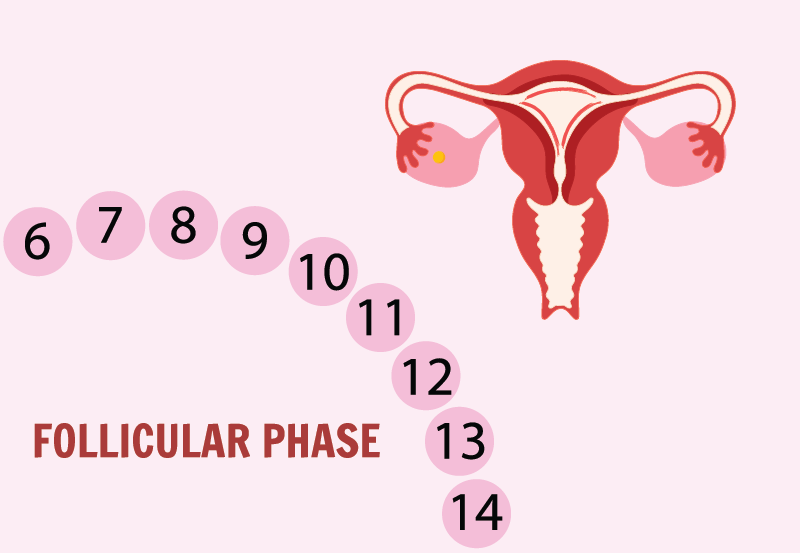
The follicular phase of the menstrual cycle is the stage in which your body gets ready for fertility and ovulation. During this stage, your energy levels are boosted, and many women experience positive mood changes.
It is essential to understand the stages of the menstrual cycle, including the follicular phase, to monitor your ovulation and enhance fertility.
What is the follicular phase of the menstrual cycle?
The follicular phase is the first half of your menstrual cycle, beginning on the first day of your period and ending with ovulation. In a typical 28-day cycle, this usually spans from Day 1 to Day 14.
Follicular phase meaning
In simple terms, “follicular” refers to the small, fluid-filled sacs in your ovaries called follicles. Each follicle contains one immature egg. The main goal of this phase is for your body to mature one of these eggs so it can be released during ovulation.
Where it fits in the menstrual cycle
The follicular phase acts as the “preparation” stage. It starts the moment your previous cycle ends and sets the foundation for the rest of your month. Because the length of this phase can vary based on stress, health, or nutrition, your period might arrive “late” or “early” in some months.
The difference between the follicular and the luteal phase
The menstrual cycle is generally split into two main halves:
- Follicular Phase (CD 1-13): Focuses on egg development and rising estrogen. It varies in length.
- Luteal Phase (15-28): Starts after ovulation. It focuses on preparing the womb for a potential pregnancy. This phase is usually quite stable, lasting about 11-17 days for most women.
The four phases of the menstrual cycle are explained

Understanding your body means looking at the full picture. Your cycle isn’t just “the period” and “the rest of the month.” It consists of four distinct stages:
| Phase | Timing | Key Hormone | What’s Happening? |
| Menstrual | Days 1–5 | Low Estrogen/Progesterone | The uterine lining sheds (your period). |
| Follicular | Days 1–13 | FSH & Estrogen | Follicles grow; the uterine lining thickens. |
| Ovulation | Day 14 (approx.) | LH (Luteinizing Hormone) | The dominant follicle releases a mature egg. |
| Luteal | Days 15–28 | Progesterone | The body prepares for a possible pregnancy. |
What happens during the follicular phase?
During the follicular phase, your body focuses on maturing a healthy egg and thickening the uterine lining for a potential pregnancy. Even while you are still menstruating, your brain and ovaries are already communicating to start the next cycle.
Brain hormone signals (FSH)
The process starts in the brain as the pituitary gland releases Follicle Stimulating Hormone (FSH). This hormone signals the ovaries to grow several follicles.
Follicular development in the ovaries
During follicular development, several small follicles grow in the ovary, like a race with many starters but only one winner.
Dominant follicle selection
Around day 7, one follicle becomes dominant and grows larger. The others stop growing and are absorbed by the body.
Estrogen rise
As the dominant follicle grows, it produces estrogen. Rising estrogen signals the brain to slow FSH and thickens the uterine lining for a possible fertilised egg.
Hormone levels during the follicular phase
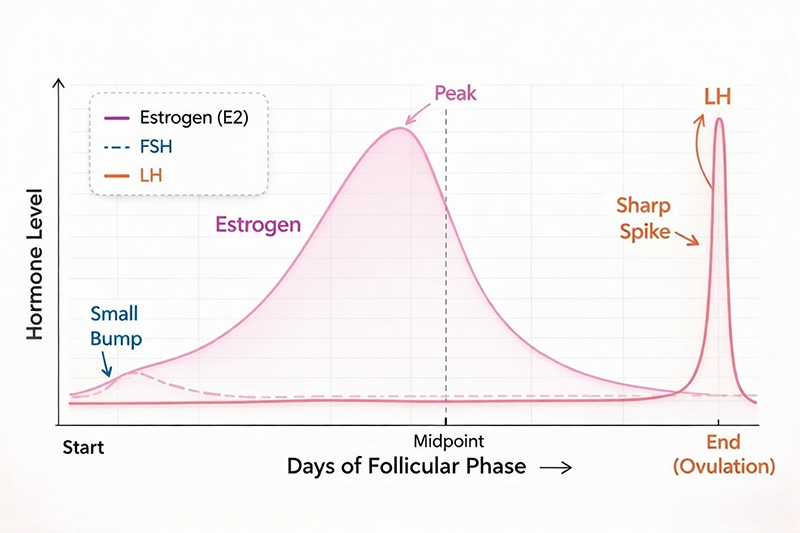
Your follicular phase hormone levels follow a specific “mountain climb” pattern.
- FSH: High at the very beginning to kickstart growth, then levels off once the dominant follicle is chosen.
- Estrogen: Starts low, often causing fatigue on day 1, and rises steadily. High estrogen produces a “glow” before ovulation.
- LH Preparation: Luteinizing Hormone stays low, but builds for a surge to release the egg.
Follicular phase symptoms: How you may feel
Rising estrogen generally produces positive symptoms during the follicular phase. Unlike the luteal phase, this is when women often feel their best.
Higher energy levels
As estrogen increases, so does your stamina. Your workouts feel easier, or you don’t need as much caffeine to get through the afternoon.
Mood improvement (follicular phase mood)
Estrogen directly affects serotonin, the “feel-good” brain chemical. Many women report feeling more social, optimistic, and resilient during this time.
Clearer skin
High estrogen levels keep skin hydrated and reduce oiliness. Hormonal acne is less common.
Increased focus
Research suggests that rising hormone levels during this phase can improve cognitive function. You might find it easier to tackle complex tasks or stay organised.
Libido changes
As you approach the end of the follicular phase (the fertile window), your libido often increases. This is nature’s way of encouraging reproduction when you are most fertile.
Follicular phase mood: Why you feel more energetic
Why do I feel good in the follicular phase?
It’s all about chemistry. Both estrogen and testosterone rise during the late follicular phase. This combination acts like a natural mood booster and energy shot. It enhances your verbal skills and makes you more “magnetic” in social settings.
What phase is a female most moody in?
Most women experience moodiness during the luteal phase, which is the time between ovulation and the start of a period. This is when progesterone rises and then drops, leading to what we commonly know as PMS.
How long does the follicular phase last?
Follicular phase length is the cycle’s biggest variable.
- Normal range: The normal range of the follicular phase is 14 to 21 days.
- Short follicular phase: If this phase is less than 10 days, the egg may not have had enough time to mature properly, which can impact fertility.
- Long follicular phase: A long follicular phase may result from stress, PCOS, or thyroid issues. It just means the body took longer to choose and mature a follicle.
Follicle growth and ovulation preparation
The health of your follicle in the ovary is a key marker of fertility.
- Dominant follicle: By the time you are ready to ovulate, the dominant follicle is the “commander” of the ovary.
- Normal follicle size day 14 (28-day cycle): A mature follicle usually measures between 18mm and 24mm before it ruptures to release the egg.
Can you get pregnant during the follicular phase?
Yes. This is a common point of confusion. While you only ovulate on one specific day, you are fertile for several days leading up to it. This is because sperm can live inside the female body for up to 5 days. If you have intercourse in the late follicular phase, the sperm can “wait” for the egg to be released.
How to support a healthy follicular phase naturally
- Nutrition: Eat healthy fats (avocados, nuts) and protein to support hormone production.
- Exercise: This is the best time for high-intensity interval training (HIIT) or heavy lifting, as your body is primed for recovery.
- Sleep: Consistent sleep helps regulate the FSH signals from your brain.
- Cycle tracking: Use a tool like Premom to see whether your follicular phase is consistent or fluctuates month to month.
How to track your follicular phase using Premom
Tracking with the Premom removes the guesswork from fertility.
- Ovulation Prediction: By logging your period and using LH strips, Premom identifies when your follicular phase slows, allowing you to predict your ovulation with precision.
- Hormone Tracking: You can see your hormone patterns mapped out in easy-to-read charts.
- Cycle Insights: Premom helps you understand if your “fertile window” is shifting, allowing you to time intercourse perfectly.
Take control of your fertility journey with Premom
Your body has its own rhythm. Understanding your follicular phase can help you get pregnant. With the Premom and our Easy@Home Ovulation Test Kits, go beyond calendar counting and track actual hormone patterns to find your unique fertile window.
Whether you are looking to get pregnant quickly or simply want to understand your fertility better, Premom is your digital companion for reproductive wellness.
[Shop Easy@Home Ovulation Test Kits] | [Download the Premom app Today]
FAQs – Follicular Phase of Your Menstrual Cycle
Her body is maturing an egg, thickening the uterine lining, and increasing the levels of energy-boosting hormones like estrogen.
Generally, she feels more energetic, confident, and social compared to other times of the month.
Yes, if you have sex during the “fertile window” (the 5 days leading up to ovulation), pregnancy is highly possible.
The main event is the growth and maturation of the dominant follicle to prepare for ovulation.
If you are bleeding, you are in the menstrual/early follicular phase. If you have “egg white” cervical mucus, you are in the late follicular phase. Tracking with an app is the most accurate way to know.
Usually, no. Bloating is most common in the luteal phase (pre-period). If you feel bloated in the follicular phase, it is usually mild and occurs right at ovulation.
Disclaimer: This content is for informational purposes only and is not a substitute for professional medical advice, diagnosis, or treatment. Always consult with a healthcare provider regarding any medical condition or before changing your health or fertility routine.
References
- Bull JR, Rowland SP, Scherwitzl EB, et al. Real-world menstrual cycle characteristics of more than 600,000 menstrual cycles. npj Digit Med. 2019;2(1). https://doi.org/10.1038/s41746-019-0152-7
- Najmabadi S, Schliep KC, Simonsen SE, et al. Menstrual bleeding, cycle length, and follicular and luteal phase lengths in women without known subfertility: A pooled analysis of three cohorts. Paediatr Perinat Epidemiol. 2020;34(3):318-327. https://doi.org/10.1111/ppe.12644
- Wieczorek K, Targonskaya A, Maslowski K. Reproductive Hormones and Female Mental Wellbeing. Women. 2023;3(3):432-444. https://doi.org/10.3390/women3030033
- Mu E, Chiu L, Kulkarni J. Using estrogen and progesterone to treat premenstrual dysphoric disorder, postnatal depression and menopausal depression. Front Pharmacol. 2025;16. https://doi.org/10.3389/fphar.2025.1528544
- Su HW, Yi YC, Wei TY, Chang TC, Cheng CM. Detection of ovula: ion, a review of currently available methods. Bioeng Transl Med. 2017;2(3):238-246. https://doi.org/10.1002/btm2.10058
- Jang D, Lybeck M, Cortes DS, Elfenbein HA, Laukka P. Estrogen predicts multimodal emotion recognition accuracy across the menstrual cycle. PLoS One. 2024;19(10):e0312404. https://doi.org/10.1371/journal.pone.0312404