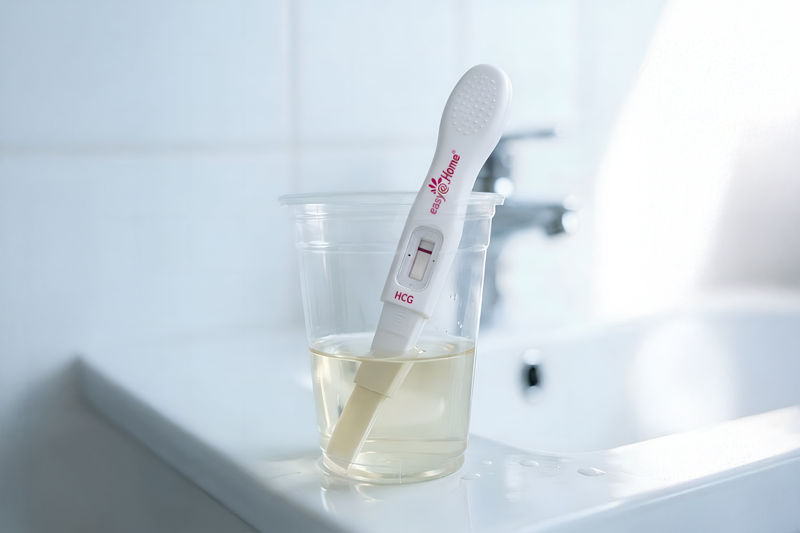
Waiting for your pregnancy test kit result can feel emotional and overwhelming. You may be eagerly watching for even the faintest line to appear on your pregnancy test results. If your result looks unclear or negative when you expected otherwise, you might wonder: Can diluted urine affect a urine pregnancy test?
The short answer is yes. A diluted urine pregnancy test may sometimes affect accuracy because it lowers the concentration of the pregnancy hormone in your sample.
Understanding how this works can help reduce confusion and guide you on the best time to check for pregnancy.
How does a urine pregnancy test work?
A urine pregnancy test kit detects a hormone called hCG (human chorionic gonadotropin). This hormone is produced after a fertilised egg attaches to the uterus.
An hCG urine pregnancy test works by identifying a specific level of this hormone in urine.
- When hCG reaches a detectable level, you may see a positive pregnancy test result.
- If hCG is not detected in the urine, you get a negative pregnancy test.
Most home urine pregnancy test kits are designed to detect hCG around the time of a missed period.
Can diluted urine actually affect pregnancy test results?
Yes, diluted urine can affect pregnancy test kit results. When you drink large amounts of water or fluids before testing, the urine becomes more diluted.
This means:
- the hCG concentration may be lower
- the test may show a pregnancy test result negative even if hCG is present
- a faint line on the pregnancy test results may appear
This is more likely in early pregnancy, typically around 4 to 6 weeks of gestation, when hCG levels are still rising rapidly.
Why urine concentration matters
The accuracy of a urine pregnancy test depends on hormone concentration.
| Urine condition | Possible effect on the result |
| Concentrated urine (first morning sample) | Higher hCG detection |
| Mildly diluted urine | May still detect hCG |
| Highly diluted urine | May lower the detection sensitivity |
A diluted urine pregnancy test does not always cause an incorrect result, but it may increase the chance of a false negative in early pregnancy.
Best time to check pregnancy

The best time to check pregnancy is usually:
- after a missed period
- early morning, using the first urine of the day
First morning urine tends to be more concentrated with Hcg hormone, which may improve accuracy.
Can a pregnancy test be wrong?
It is natural to ask:
- can a pregnancy test be wrong?
- can pregnancy kit be wrong?
- can a pregnancy test have a false positive?
False negative
A pregnancy test results negative may happen if:
- the test was taken too early
- urine is diluted
- the test instructions were not followed correctly
False positive
A pregnancy test positive result may rarely occur due to:
- recent pregnancy loss
- certain medications containing hCG
- medical conditions (rare)
If results are confusing, repeat the test after 48-72 hours or consult a healthcare provider.
Understanding positive and negative pregnancy test results

Pregnancy test positive result
A clear second line on a pregnancy test, even if faint, may indicate hCG detection, suggesting early pregnancy.
Pregnancy test results negative
If your urine pregnancy test shows negative, but your period has not started:
- wait for 2-3 days
- retest using the first morning urine
- monitor symptoms
Hormone levels often double every 48-72 hours in early pregnancy.
When to take pregnancy test for best accuracy
Here is a simple guide:
| Situation | Suggested timing |
| Regular cycles | After a missed period |
| Irregular cycles | 14 days after suspected ovulation |
| Testing early | 1-2 days before missed period (may require repeat testing) |
Taking a test too early increases the chance of a pregnancy kit’s negative result, even if pregnancy is developing.
What to do if you suspect diluted urine affected your result
If you think urine dilution may have affected your pregnancy test kit result:
- avoid excessive fluid intake for a few hours before testing
- use first morning urine
- follow instructions carefully
- repeat the test after 48 hours if needed
If repeated tests are unclear or inconsistent, consult a healthcare professional for further evaluation.
Final thoughts
Can urine dilution affect pregnancy test results? Yes, especially in early pregnancy when normal hCG levels are still low. A diluted urine pregnancy test may increase the chance of a pregnancy test results negative even if pregnancy has begun.
Testing at the best time to check pregnancy, typically after a missed period and using first morning urine, may improve clarity and reduce uncertainty.
If the results remain unclear, repeat the test after a few days, as hCG levels typically rise every 48 to 72 hours in early pregnancy.
You can also upload your test results to the Premom app for tracking and better interpretation. If you need further guidance, please reach out to us through the AAE feature for personalised support.
When to consult a healthcare provider
Seek medical advice if you are experiencing:
- repeated negative results but no period for several weeks
- confusing or inconsistent results
- severe abdominal pain
- unusual or heavy bleeding
Professional evaluation may include blood hCG testing or even an ultrasound if needed.
FAQ’s – urine pregnancy test
Yes, but early morning testing may provide more concentrated urine with hCG hormone and clearer results.
Home tests are highly accurate when used correctly, but timing and urine dilution may affect results.
It is usually best to test after a missed period using first morning urine.
A faint line may indicate early hCG detection. Retesting after 48 hours may provide clearer results.
Disclaimer: This content is for educational purposes only and is not medical advice. Please consult a healthcare professional for personalised guidance.
References
- Cleveland Clinic. Pregnancy Tests: When to Take, Types and Accuracy. https://my.clevelandclinic.org/health/diagnostics/9703-pregnancy-tests
- Mayo Clinic. Home pregnancy tests: Can you trust the results? https://www.mayoclinic.org/healthy-lifestyle/getting-pregnant/in-depth/home-pregnancy-tests/art-20047940
- U.S. Food and Drug Administration. Pregnancy Tests: What You Should Know.
https://www.fda.gov/medical-devices/home-use-tests/pregnancy - American College of Obstetricians and Gynecologists. Early Pregnancy Loss and hCG testing information. https://www.acog.org